
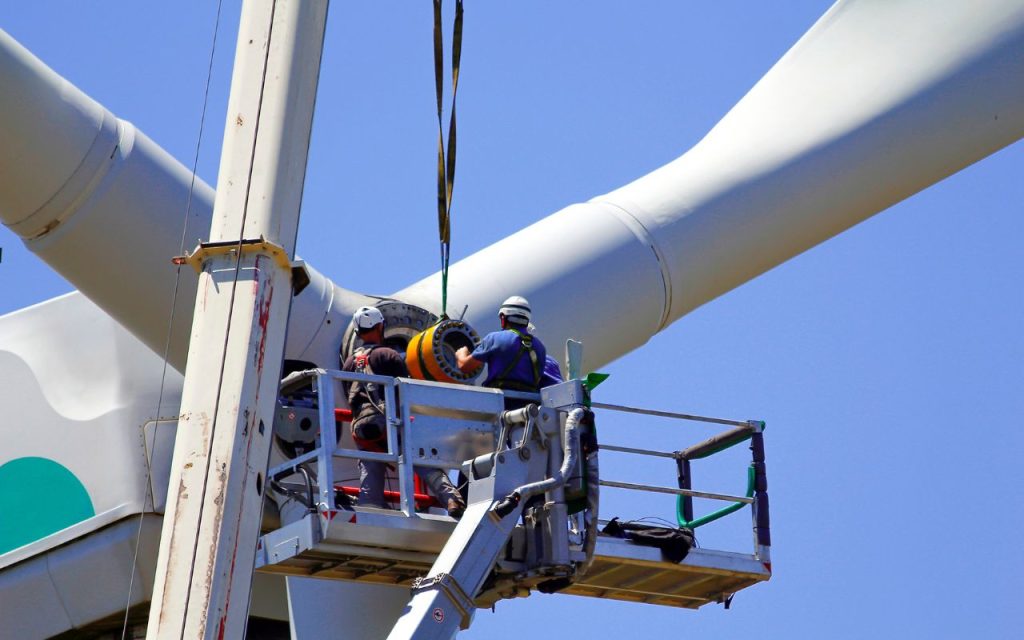
L’éolienne est une machine qui transforme l’énergie du vent en électricité. Elle est composée d’une turbine qui est entraînée par le vent, et d’un générateur qui convertit l’énergie mécanique de la turbine en électricité. L’éolienne peut être utilisée pour alimenter des bâtiments ou des véhicules électriques, ou pour produire de l’électricité pour le réseau électrique. Voyons comment il est possible de transformer l’énergie fournie par le vent en électricité grâce aux éoliennes.
Les éoliennes et le principe de la conversion de l’énergie du vent en électricité
L’éolienne est un appareil, ou une installation, qui transforme l’énergie du vent en électricité. Le principe de fonctionnement de l’éolienne est relativement simple : lorsque le vent souffle, les pales de l’éolienne sont entraînées et font tourner un axe central. Cet axe est relié à un générateur qui transforme l’énergie mécanique du mouvement des pales en énergie électrique.
L’électricité issue de l’énergie éolienne peut être utilisée pour alimenter des appareils électriques tels que des lampes ou des ventilateurs, mais elle peut aussi être connectée à un réseau électrique pour alimenter une zone entière en électricité.
Lorsqu’elles sont installées en grand nombre, les éoliennes peuvent constituer une importante source d’énergie renouvelable et propre.
Plusieurs facteurs influencent le rendement d’une éolienne, notamment la vitesse du vent, la taille et la forme des pales, ainsi que l’angle d’inclinaison de celles-ci par rapport au vent.
Les éoliennes sont généralement classées selon leur diamètre : les plus petites ont un diamètre inférieur à 10 mètres, tandis que les plus grandes peuvent atteindre 100 mètres de diamètre ou plus.
Les éoliennes dans le monde
Les éoliennes sont des appareils qui utilisent l’énergie du vent pour produire de l’électricité. C’est une source d’énergie renouvelable et propre, ce qui en fait un choix populaire en faveur de la lutte contre le réchauffement climatique dans le monde entier.
Chaque éolienne est composée de plusieurs parties, notamment une hélice ou rotor, un moteur et une génératrice. Lorsque le vent souffle, il fait tourner les pales de l’hélice, ce qui entraîne le moteur. Le moteur est connecté à la génératrice, qui transforme l’énergie mécanique du mouvement du vent en énergie électrique.
Cette technologie ancienne est utilisée depuis des siècles pour diverses tâches, notamment le pompage d’eau et la mouture du grain. Par exemple, dans le temps, la force du vent pouvait être utilisée par les moulins à vent.
Au cours des dernières décennies, l’éolienne a connu une croissance rapide en tant que source d’énergie renouvelable. Aujourd’hui, il existe plus de 200 000 éoliennes dans le monde, principalement en Europe et en Amérique du Nord. En 2017, l’énergie éolienne a représenté 4 % de la production d’électricité mondiale.
L’avenir de l’éolienne est prometteur. Les prix des éoliennes ont considérablement baissé au cours des dernières années et continuent de baisser. En outre, les éoliennes deviennent de plus en plus grandes et de plus en plus efficaces.
De nouveaux types d’éoliennes, comme les éoliennes flottantes, sont en cours de développement et devraient être commercialisées dans les prochaines années. Si les tendances actuelles se poursuivent, l’éolienne devrait jouer un rôle important dans la production d’électricité verte à l’avenir.
L’éolienne, une alternative écologique ?
Il peut s’agir d’une alternative écologique aux moteurs à combustion interne, car l’énergie éolienne ne produit pas de gaz à effet de serre. En utilisant l’énergie du vent pour produire de l’électricité, les éoliennes disposent d’une ressource en énergie renouvelable et inépuisable.
En revanche, pour certains, les éoliennes ne sont pas du tout écologiques. De ce fait, tout dépend de ce que vous entendez par écologique. En effet, toute production d’énergie a un impact sur l’environnement. Notamment si l’on considère les ressources nécessaires à la fabrication, à l’entretien et au recyclage.
De plus, les éoliennes sont très régulièrement critiquées pour leur impact sur la biodiversité et les bouleversements de paysage qu’elles entraînent. En effet, les éoliennes ne sont pas les installations les moins visibles, d’autant qu’il faut une quantité importante d’éolienne pour produire une quantité d’électricité suffisante.
Toutefois, si nous regardons les données climatiques, les éoliennes sont en tête du classement climatique en compagnie de l’énergie hydraulique et nucléaire.
De plus, quand on regarde l’énergie grise dédiée à son cycle de vie (qui représente toute l’énergie qui doit être utilisée, de la fabrication au recyclage), les éoliennes émettent en réalité 80 fois moins de gaz à effet de serre que le charbon, 40 fois moins que le gaz naturel, ou même quatre fois moins d’énergie solaire.
Nous retiendrons donc que l’éolienne est un appareil permettant de transformer l’énergie du vent en électricité. Les éoliennes sont de plus en plus utilisées dans le monde entier car elles représentent une source d’énergie renouvelable et propre. Les éoliennes peuvent également être très efficaces et peuvent produire beaucoup d’électricité à partir du vent même si leur installation est souvent critiquée et contestée.